


Quick Answer
In AI Agents 2026, an AI agent is a software application that can plan and execute a set of steps by itself and complete tasks with minimal human supervision. In 2026, AI agents can already write and debug code, respond to customer support tickets, book travel itineraries, perform internet research across dozens of web pages, and even handle specific marketing or financial workflows. However, they are still limited in their ability to make judgement calls, take into account physical realities, and retain information over extended periods of time. More than fifty percent of large companies have already adopted at least one AI agent in their day-to-day operations, according to the Q1 2026 KPMG AI Pulse Survey.
You have likely come across the term AI agent at some point this year. However, there is a large difference between what is being advertised and what you might discover yourself. Let’s discuss what an AI agent really is.
What Is an AI Agent, Really?
A chatbot replies to a question. An AI agent completes a task.
That’s the difference. The first is a simple AI, something like a chatbot that waits for you to ask a question, then replies and stops. The second is an AI agent, which actually does something. It looks at a task you’ve asked it to complete (“find me 3 flights costing under £400 and book the cheapest”), breaks it down into steps, uses external services (a search engine, a calendar, an email client, a browser) to accomplish it, and checks it off as done when it’s actually done or throws up its hands in frustration if something goes wrong.
In short, agents act. Chatbots don’t.
What Can AI Agents Actually Do in 2026?
Here’s where things get practical. These are jobs agents are handling right now, not theoretical ones.
Writing and Fixing Code
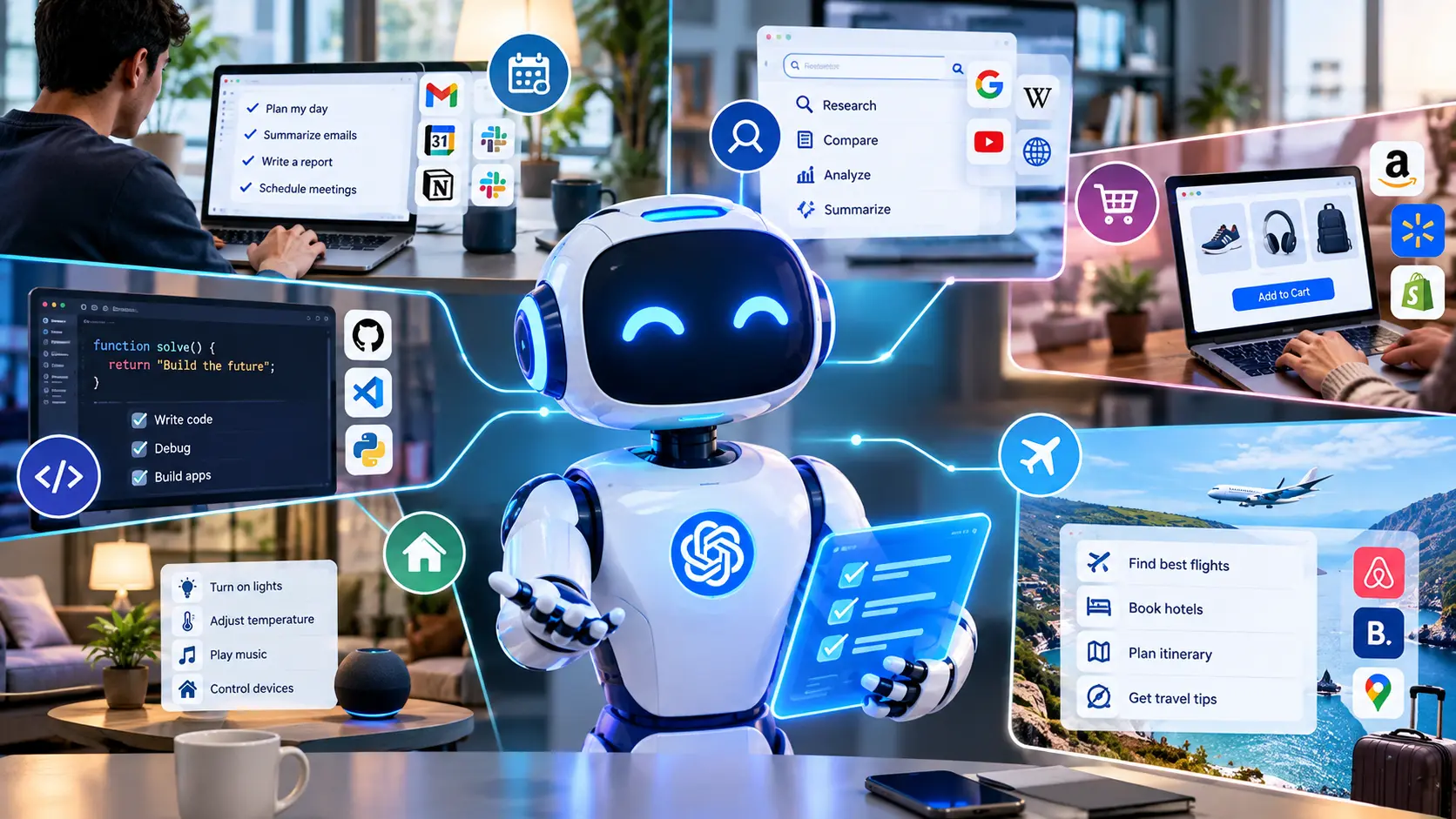
Coding agents can now read an entire codebase, find a bug, write the fix, test it, and open a pull request — often without a developer touching the keyboard. Teams use them for routine work: adding tests, cleaning up old code, or building small features from a plain-English brief.
Customer Support
Support agents read the ticket, open the customer’s order history, review the return policy, and issue a refund or response. Gartner predicts that by 2029, agentic AI will solve most customer service problems on its own, without needing humans to answer. And that future is already being prepared during this year.
Research and Summarising
Ask an agent to research a topic and it can search the web, open dozens of pages, cross-check facts, and hand you a short summary with sources — a task that would take a person hours.
Booking and Scheduling
Travel and calendar agents can compare flights, check your calendar for conflicts, book a hotel within budget, and send you a confirmation — no back-and-forth needed.
Finance and Admin Tasks
In finance teams, agents reconcile invoices, flag unusual transactions, and draft reports. In HR, they screen CVs and schedule interviews. None of this is science fiction anymore — it’s a Tuesday afternoon at a mid-sized company.
How Many Businesses Are Actually Using Them?
The figures speak for themselves. According to KPMG’s Q1 2026 AI Pulse Survey, 54% of organizations currently use AI agents in core operations compared to only 11% two years ago. A 2025 State of AI report from McKinsey finds that 62% of organizations are experimenting with AI agents while 23% have already scaled their use in at least one business function. Gartner predicts that 40% of enterprise applications will have a task-specific AI agent by the end of 2026 up from less than 5% in 2025.
The market reflects this explosive growth. The global AI agent market is set to reach around $10.9 billion in 2026, heading toward $50 billion by 2030, suggests Grand View Research.
| Stat | Figure | Source |
| Orgs running agents in production | 54% | KPMG, 2026 |
| Orgs experimenting with agents | 62% | McKinsey, 2025 |
| Enterprise apps with embedded agents by end of 2026 | 40% | Gartner |
| Global AI agent market size, 2026 | ~$10.9bn | Grand View Research |
What Can’t AI Agents Do Yet?
This is the part most articles skip. Agents still fall short in a few clear ways:
Judgement calls. An agent can help draft a legal letter, but shouldn’t be relied on to make the call on if/when it is sent without a human reviewing the tone and facts.
Long memory. Most agents forget what happened in the previous conversation (unless it was hard-coded). They can’t really “remember” you like a human assistant might.
Messy, ambiguous goals. An agent does best when given a clear directive toward a concrete end. The type of “make our marketing better” goal still needs human decomposition.
High stakes failures. Gartner also predicts that over 40% of agentic AI initiatives will be cancelled by 2027 due to unrealized value or budget, a sobering reminder that not every application is a good one. So, if you’re thinking about an agent for your own system, consider the risks before investing.
A good rule of thumb for using and agentic system? Apply it to concrete tasks with clear completion criteria (for the computer). Have humans handle anything legally, financially, or reputationally risky.
Getting Started With AI Agents
You don’t need an enterprise budget to try one. Most people start with a single, narrow task — replying to routine emails, researching a topic, or organising a calendar — before handing over anything bigger. Pick one repetitive task this week, try an agent on it, and see how much of it you’d actually trust to run unsupervised. That’s a better test than any demo.
Frequently Asked Questions
What’s the difference between an AI agent and a chatbot?
A chatbot answers questions when you ask them. An AI agent plans and carries out multi-step tasks on its own, using tools like search, email, or a calendar, and only stops once the job is finished.
Are AI agents safe to use for business tasks?
Yes, for the right tasks. Agents work well for tasks with a clear goal and a checkable result, such as data entry or research. For anything with legal, financial, or reputational risk, keep a human reviewing the output before it goes live.
How many companies use AI agents in 2026?
Around 54% of organisations are running AI agents in core operations as of early 2026, according to KPMG, and 62% are experimenting with them in at least one area, per McKinsey.
Can AI agents replace human employees?
Not entirely. Agents are best at repetitive, well-defined tasks. Jobs that need judgement, creativity, or handling unexpected situations still need a person involved, at least for now.
What industries are using AI agents the most?
Customer service, software development, finance, and HR are leading the way, using agents for support tickets, code fixes, invoice reconciliation, and CV screening.
Do I need technical skills to use an AI agent?
No. Many agent tools now work through plain-English instructions, similar to chatting with an assistant. Technical skill helps for custom setups, but basic use doesn’t require coding.
A Quick Word Before You Go
AI agents in 2026 are neither magic nor a hyped-up solution. They are rather a viable tool for specific well-defined and repetitive tasks, an unviable option for any activity requiring judgment. Start small and keep a human in the loop for the critical decisions, and you will reap big rewards compared to companies that try to fully automate everything right away.