

As modern software evolves beyond basic automation, agentic AI is emerging as the next major leap in technology. Unlike static tools, agentic AI systems can independently plan, adapt, and execute multi-step workflows to achieve complex goals with minimal human intervention.
Have you ever asked an app to “just handle it” and longed for the day that wish actually came true? Well, brace yourselves – that day is coming! Dubbed “agentic AI”, this new technology trend is set to revolutionize the way we interact with apps, and we’re seeing the fruits of its early development in 2026. In this article, you’ll discover what agentic AI really means, how it works, and whether it will truly make our apps more intelligent than they already are.
What Is Agentic AI, Really?
Agentic AI represents a paradigm shift in artificial intelligence systems, enabling them to possess the capability to reason, plan, and act upon reaching an answer, rather than simply waiting for an input like “Write me an email.” An agentic AI can perform multiple steps to accomplish a goal rather than following strict step-by-step instructions.
Suppose I wanted to book a flight to Delhi on the next Friday under a certain budget of Rs 8000. A traditional application would offer me a search bar while an agentic AI would automatically search available flights meeting my price range and check if my schedule allows me to fly on the next Friday and get back to me with the confirmed bookings
How It’s Different From a Chatbot
A chatbot is designed to answer questions, a copilot suggests texts or lines of code and waits for the person to press the accept button, and an agent goes beyond this by taking action itself, only stopping to ask for permission when it needs to make a sensitive decision, such as when making payments.
In other words, the difference between a chatbot, a copilot, and an agent is that a chatbot requires waiting for each query, a copilot suggests texts or lines of code but requires a person to execute them, and an agent takes action on its own and only stops to ask for permission when it needs to make a sensitive decision.
How Agentic AI Actually Works
Most agentic systems follow a loop, not a single step:
- Understand the goal — it reads your request and figures out what “done” looks like.
- Break it into tasks — big goals get split into smaller, doable steps.
- Use tools — it connects to apps, websites, or databases to get things done, not just talk about them.
- Check its own work — it looks at the result and decides if it met the goal or needs another pass.
- Act again or stop — it keeps going until the task is completed or requires human oversight
- which represents a fundamental shift over previous software. Agentic AI is about decomposing a goal into tasks, using APIs, interacting with external systems like email, CRM or the web, and iterating until completion.
- A core part of this shift involves a new kind of secure connector, allowing AI access to other tools and data in a safe way. Anthropic’s Model Context Protocol (MCP) was released in late 2024 as an open standard for connecting AI systems to external data and tools, and by early 2026 thousands of MCP connectors had been created, integrated into ChatGPT, Cursor, Gemini, Copilot and more.
Agentic AI vs. Traditional Apps: What’s the Real Difference?
| Traditional App | Agentic AI | |
| How you use it | You click, type, and navigate menus | You state a goal in plain language |
| What it does | Waits for your next input | Plans and acts across multiple steps |
| Where it works | Inside its own interface | Across several apps and tools at once |
| Who does the work | You, guided by the app | The AI, with you approving key steps |
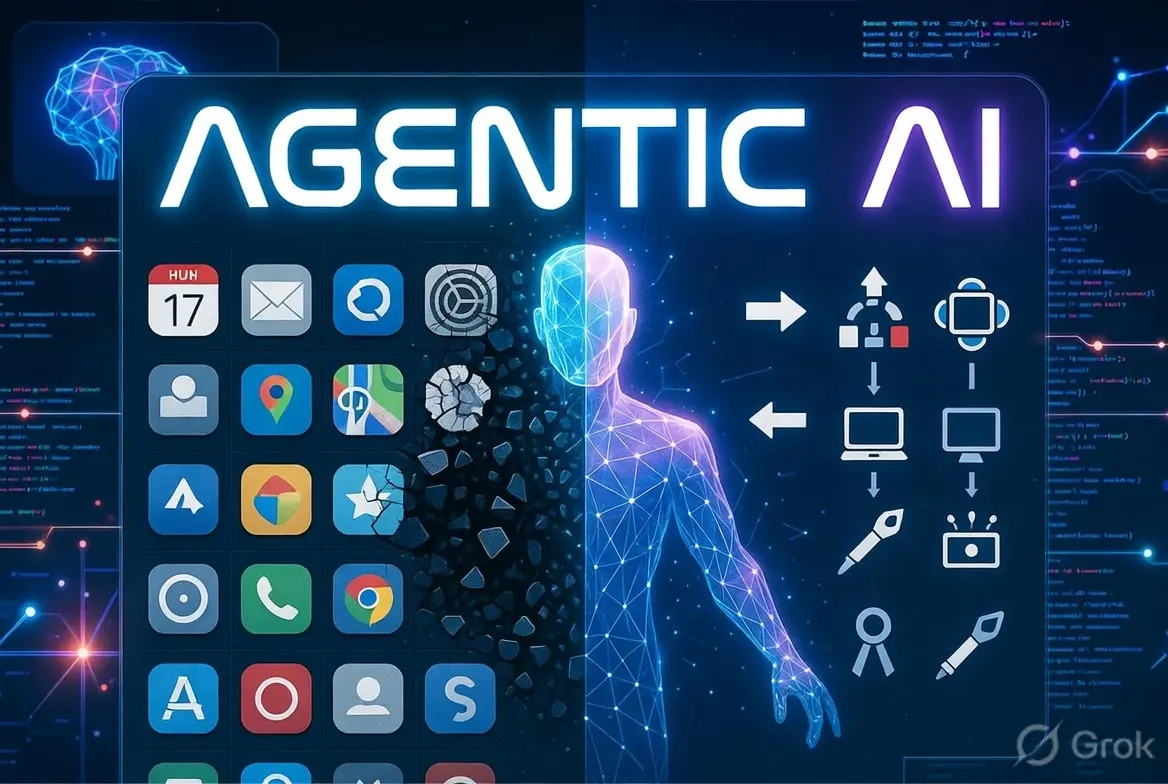
Traditional apps are built around screens. Agentic AI is built around outcomes. That single difference is why some people think the app icon on your home screen might slowly matter less.
Will Agentic AI Replace Traditional Apps?
Not overnight, and probably not completely. Here’s a more honest way to think about it:
- Simple, repetitive tasks (booking, scheduling, filing expense reports) are the easiest for agents to take over first.
- Complex creative or judgment-heavy work still needs a human driving, at least for now.
- Legacy systems in banks, hospitals, and government offices are not always seamlessly integrated with AI agents, which can create challenges. Older systems may not be designed to work with new technologies, requiring careful coordination to ensure compatibility while maintaining security.
The realistic picture is that apps are not going to disappear, but the UI is going to change, such that instead of opening ten apps to plan a trip, you might tell one agent what you want to do and it would do it all for you in the background.
Real Examples of Agentic AI in Action (2026)
This isn’t just theory anymore. Businesses are already putting it to work:
- Finance teams use agents to match invoices against bank statements automatically. Reported results show 60 to 80 percent cuts in manual reconciliation time for teams that adopted this.
- Banks are using agents for compliance checks. McKinsey reports banks utilizing generative AI for know your customer and anti-money laundering have seen productivity gains per task ranging from two to 20 times higher.
- Customer support agents now resolve tickets end-to-end — checking account history and applying policy — rather than just drafting a reply for a human to send.
- Travel planning agents can compare flights and hotels to your calendar and make the bookings once you’ve approved the options. With access to your credit card (or other means of payment), an agent can even book and pay for everything on its own.
The Challenges Nobody Talks About
Agentic AI sounds great in a demo. In the real world, it runs into problems:
- Trust and explainability. When an agent makes a decision, it’s not always clear why — a real issue in fields like healthcare where documentation is required by law.
- Integration headaches. A large share of teams report friction connecting agents to their existing tools and data.
- Overhyped expectations. Analysts at Gartner have placed AI agents at the “peak of inflated expectations” on their well-known hype cycle, warning that most agentic AI projects right now are still early experiments dressed up as finished products.
- Keeping a human in the loop. The safest systems aren’t the ones with zero human involvement — they’re the ones that know exactly when to pause and ask.
Is Your Business Ready for Agentic AI?
Before you begin your RPA journey, there are three critical questions that you need to answer honestly. Firstly, is the process you want to automate transactional and rules-based or does it require judgment or decision-making? Secondly, do you have systems with good data to support the robotic process? Thirdly, is there a proper approval process for any high-risk actions such as payments or access to sensitive data? These three considerations are essential to any company looking to implement RPA.
FAQs About Agentic AI
What is agentic AI in simple words?
Agentic AI is a form of artificial intelligence capable of recognizing a need, coming up with a plan, and executing it using technology and applications in order to satisfy the requirement, rather than just responding to a direct request.
How is agentic AI different from generative AI?
The basic difference between generative and agentic AI is that generative AI creates content, such as text or an image, based on a prompt while agentic AI goes further and performs an action based on the result or the decision, which usually involves multiple steps and requires lesser level of supervision.
Can agentic AI replace human jobs?
It’s more likely to replace repetitive tasks within jobs than entire jobs at once. Most current use cases pair agents with human approval for anything sensitive.
Is agentic AI safe to use for business?
It can be, if you set clear boundaries — human approval for risky actions, clean data, and monitoring. Rushing an agent into production without those guardrails is where most failures happen.
Will agentic AI replace apps completely?
Not fully, and not soon. Expect agents to sit on top of your existing apps first, quietly handling multi-step tasks, before entire interfaces are redesigned around them.
The Bottom Line
Agentic AI is no longer a thing of the future. It’s already being used for tasks like booking travel arrangements, reconciling invoices, and triaging customer support tickets in several practical business applications today. The apps on your phone this year are unlikely to disappear, but the ways in which you interact with them will change. Try delegating one recurring task this week to an agentic tool and observe how much of it you can get out of the way.
Resources for Further Reading
- MIT Sloan — Agentic AI, Explained
- Blockchain Council — Agentic AI Explained: How It Works in 2026
- Generative, Inc. — Agentic AI in 2026: From Chatbots to Autonomous Agents
- Academy Class — What Is Agentic AI? A Practical Guide for 2026