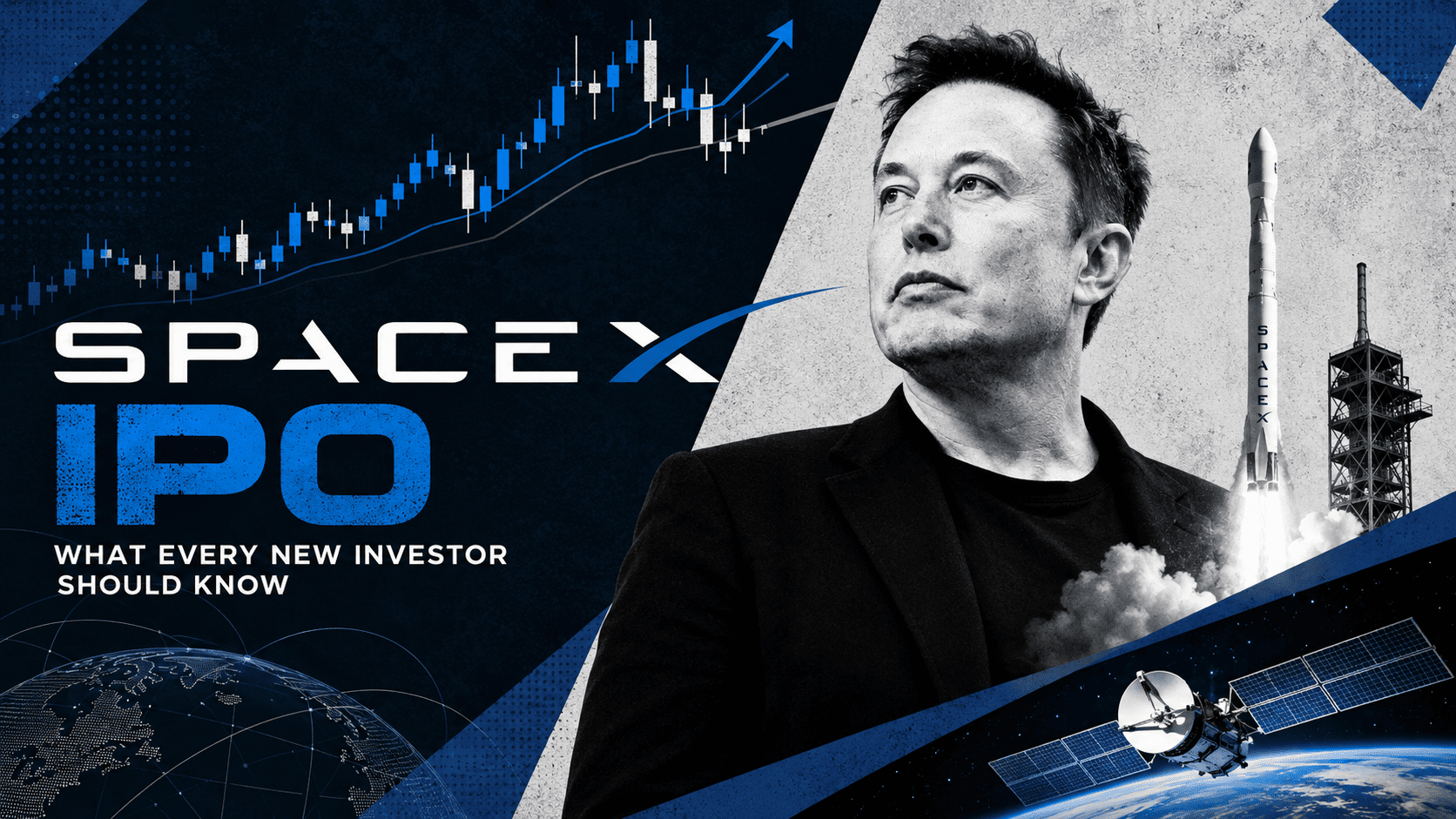

You’ve probably heard the buzz. SpaceX — the rocket company that sends astronauts to space, beams internet from satellites, and dreams of putting humans on Mars — just made history. On June 12, 2026, SpaceX began trading on the Nasdaq under the ticker SPCX, pulling off what is now officially the largest IPO in stock market history.
It is being called the largest initial public offering (IPO) in history, hitting the market with an implied valuation of around $1.75 trillion. For everyday retail investors, this is the ultimate frontier. If you’re a new investor wondering what it all means, whether you missed the boat, and what happens next — you’re in the right place. Let’s break it all down, simply and clearly.
If you’re a new investor wondering what it all means, whether you missed the boat, and what happens next — you’re in the right place. Let’s break it all down, simply and clearly.
What Is SpaceX, Really?
Most people know SpaceX as “Elon Musk’s rocket company.” But that’s only part of the story.
SpaceX — formally Space Exploration Technologies Corp. — was founded in 2002 with one bold goal: make humanity a multi-planetary species. Over two decades, it grew from a scrappy startup into one of the most powerful aerospace companies on the planet.
Today, SpaceX operates across three major business areas:
- Space launches — Falcon 9 rockets carry satellites, cargo, and crew to orbit
- Starlink — a satellite internet network beaming broadband to millions worldwide
- AI (SpaceXAI) — after acquiring xAI (Elon Musk’s AI company) in early 2026, SpaceX now has a rapidly growing artificial intelligence division
In 2025, the company pulled in $18.67 billion in revenue. Starlink alone accounts for roughly 61% of total revenue, making it the engine that really drives the business.
What Is an IPO, and Why Does It Matter?
An IPO — Initial Public Offering — is when a private company sells shares of itself to the public for the first time. Before an IPO, only wealthy investors, venture capital firms, and company insiders can own a piece of the business. After the IPO, anyone with a brokerage account can buy in.
For SpaceX, this was a massive shift. For years, Elon Musk insisted the company would stay private. He worried that the pressure of quarterly earnings reports would conflict with SpaceX’s long-term, sometimes risky goals. But the commercial success of Starlink changed the equation. The business had grown big enough — and profitable enough in key segments — to go public.
The IPO was internally codenamed “Project Apex”, which feels very on-brand.
The Numbers Behind the Historic Debut
Let’s look at the headline figures:
- IPO price: $135 per share
- Opening on June 12, 2026: SPCX jumped nearly 19%, closing at around $161
- Valuation at IPO price: $1.77 trillion
- Total capital raised: approximately $75 billion
- Shares offered: 556.6 million shares
- Lead underwriter: Goldman Sachs, alongside Morgan Stanley, JPMorgan, Bank of America, and Citigroup (21 banks in total supported the deal)
To put the scale in perspective — one estimate suggests SpaceX alone raised more money than all U.S. IPOs in 2024 and 2025 combined. That’s not a typo.
What Makes SpaceX Different from Other IPOs?
A few things stand out about this particular debut.
1. Unusually High Retail Investor Allocation
Most big IPOs reserve only 5–10% of shares for regular retail investors. The big allocations go to institutional investors — pension funds, hedge funds, and large banks.
SpaceX reportedly set aside up to 30% of IPO shares for retail investors — at least three times the usual amount. This was a deliberate move, with a dedicated event held for around 1,500 retail investors on June 11, the day before trading began.
Retail-friendly platforms like Robinhood, Fidelity, Charles Schwab, SoFi, and E*TRADE gave eligible customers a chance to request shares at the $135 IPO price. Allocation wasn’t guaranteed, but the access itself was unusually broad.
2. The Starlink Factor
Starlink is the crown jewel of the SpaceX business. It operates a constellation of over 7,500 satellites in low Earth orbit — the largest active satellite network ever deployed. It’s also the only profitable segment within the company.
When analysts talk about SpaceX’s long-term valuation, Starlink is central to the story. The global space economy is projected to reach $1 trillion by 2034 (up from $626 billion in 2025, according to Novaspace). Starlink is positioned to capture a huge chunk of that growth.
3. SpaceX Is Also an AI Company Now
In February 2026, SpaceX acquired xAI — Musk’s artificial intelligence company, which also owns X (formerly Twitter) — in an all-stock deal valued at roughly $250 billion. By May 2026, the division was fully absorbed and rebranded as SpaceXAI.
This means SPCX is not just a space stock. It’s a space, internet, and AI conglomerate. That complexity adds opportunity — and risk.
The Honest Risks Every New Investor Should Know
Here’s where I need to be real with you. The SpaceX story is genuinely exciting. But investing is never just about excitement.
High Valuation, High Expectations
At $135 per share and a $1.77 trillion valuation, SpaceX was priced at roughly 60 times its annual sales. That’s a sky-high multiple, even by tech standards. Analysts warn that at such a price, buyers are betting on flawless execution across multiple ambitious projects — rockets, satellites, AI — all at once.
As one NPR analyst put it plainly: “Investing in an IPO process can be highly speculative.” He added that anyone thinking about participating should approach it only “in a speculative way” rather than as a long-term core holding.
The Company Ran at a Loss in 2025
Despite strong revenue, SpaceX posted a loss of nearly $5 billion in 2025. Much of that was tied to the integration of xAI and heavy spending on AI infrastructure. R&D costs in the AI segment jumped over 300% in one year. That’s not necessarily alarming for a growth company — but it’s something to know going in.
Musk’s Other Ventures Can Affect the Stock
SpaceX’s story is inseparable from Elon Musk. His focus, reputation, and time are shared across SpaceX, Tesla, X, and his political activities. When Musk’s attention shifted to leading DOGE in 2025, Tesla’s share price and profits took a notable hit. The same dynamic could influence SPCX.
Competing Space Stocks Fell on IPO Day
When SPCX began trading, investors rotated money into SpaceX and out of smaller space companies. Rocket Lab, Intuitive Machines, and Firefly Aerospace all dropped 10–18% on the same day. If you already hold space-sector ETFs or individual names, worth noting.
How Can You Actually Buy SpaceX Stock?
Since SPCX is now publicly traded, buying shares is straightforward:
- Open a brokerage account if you don’t already have one — Fidelity, Schwab, Robinhood, and others all support Nasdaq-listed stocks
- Search for the ticker SPCX on your platform
- Decide how much you want to invest — you can buy fractional shares on most platforms, so you don’t need $161 for a single share
- Place your order — a market order buys at the current price, a limit order lets you set the price you’re willing to pay
One practical tip: don’t rush. IPO stocks are often volatile in the first weeks of trading. SPCX’s first-day price range alone was $149 to $176. Patience can serve new investors well.
Should You Invest? A Simple Framework
Here’s a quick way to think it through:
- You might consider buying if you have a long-term horizon (5+ years), believe in the space economy’s growth, and are comfortable with high-risk, high-reward investments
- You should wait or skip if you’re investing money you might need soon, if you’re uncomfortable with volatility, or if the current valuation feels stretched to you
A diversified approach — putting a small portion of your portfolio into SPCX rather than going all-in — is the approach most financial advisors would suggest for a speculative position like this.
A Historic Moment, But Stay Grounded
The SpaceX IPO is genuinely one-of-a-kind. It’s the largest public market debut in history. It opens up a company that has redefined rocketry, built the world’s biggest satellite network, and now pushes into artificial intelligence. For investors who believe in the long arc of the space economy, SPCX offers a front-row seat.
But front-row seats come at a price — literally. The stock is richly valued, the company is running at a loss, and there’s meaningful uncertainty in every direction. Great companies bought at expensive prices can still disappoint.
So do your homework. Understand what you’re buying. And if you decide to invest — welcome aboard. The view from orbit is pretty spectacular