


| Quick answer: Yes. The measles outbreak in us 2026 has put the country in the middle of its worst viral surge in over 30 years. As of 1 October 2026, the CDC had confirmed 3,887 cases across 47 states and jurisdictions — already more than all of 2025 and the highest total since 1991. Most cases are linked to unvaccinated communities. |
If you’ve seen measles in the headlines lately and wondered whether it’s actually a problem where you live, the short answer is: it might be. Measles is back in a way it hasn’t been in decades, and it’s spreading fastest in places where fewer people are vaccinated. Here’s a simple, no-jargon look at what’s going on, what symptoms to watch for, and what you can do to stay safe.
How Big Is the US Measles Outbreak in 2026?
It is significant, significantly higher than the previous year, and the highest number of reported cases since the disease began its decline in the mid-1990s. According to the CDC (Centers for Disease Control and Prevention), 3,887 cases of measles have been reported as of 1 October 2026 nationwide, across 47 states, territories, and Washington, DC. This represents an increase of 52% year-on-year since 2,289 cases of the viral illness were reported in 2025, and is the highest number since 9,643 cases were recorded in 1991.
Out of the 3,887 cases, approximately 95 percent of them are part of a large outbreak or three or more connected cases. There have been 42 outbreaks recorded this year alone. Since 2000, measles, a highly contagious viral infection, has been declared “eliminated” from the US. That means that there has not been a continuous chain of transmission of the illness. However, experts argue that this year, due to the number of measles cases reported, the elimination will be at risk.
The majority of measles cases this year are connected to insufficient vaccination coverage. Approximately 9 out of 10 persons who got infected with measles either are unvaccinated or their vaccination status is unknown. The outbreaks mainly erupt in close-knit groups where measles vaccine coverage is below the 95 percent needed to prevent the spread of the illness.
What Are the Symptoms of Measles?
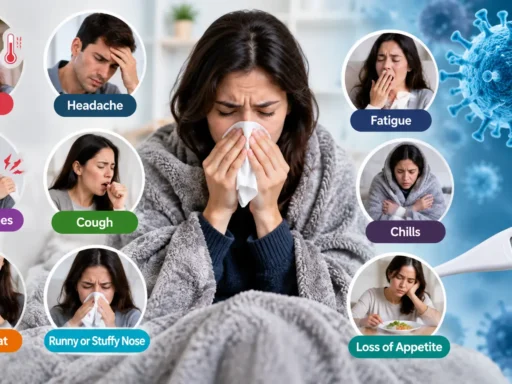
Measles doesn’t jump straight to the rash everyone pictures. It builds up over about a week, starting with symptoms that look a lot like a bad cold or flu.
| Stage | What happens | When |
| Early signs | High fever, dry cough, runny nose, red watery eyes | Days 1–4 after symptoms start |
| Koplik spots | Tiny white spots inside the cheeks | 2–3 days before the rash |
| Rash | Red, blotchy rash starting on the face, spreading down the body | 3–5 days after first symptoms |
| Contagious period | Can spread the virus to others | 4 days before to 4 days after the rash appears |
The classic order is: fever first, then a cough, runny nose, and red eyes, then tiny white spots inside the mouth (called Koplik spots), and finally the rash itself. The rash usually starts on the face and hairline, then spreads down to the chest, arms, and legs over a few days. Fever can spike as high as 104–105°F right around the time the rash appears.
People with measles can pass it on to others for four days before the rash shows up and four days after, which is part of why it spreads so easily — you’re contagious before you even know you’re sick.
Who Is Most at Risk?
Measles can make anyone unwell, but some groups face a much higher chance of serious complications:
- Babies and toddlers under 5
- Pregnant people
- Anyone with a weakened immune system
- Unvaccinated people of any age, especially those who’ve never had measles before
Complications aren’t rare, either. Roughly 1 in 5 unvaccinated people who catch measles ends up in hospital. About 1 in 20 children with measles develops pneumonia, which is the most common cause of measles-related death in young children. A smaller number, around 1 in 1,000, develops encephalitis (swelling of the brain), which can cause seizures or lasting brain damage.
How Do You Protect Yourself and Your Family?
The good news is that measles is one of the easiest serious diseases to prevent. The MMR vaccine (measles, mumps, and rubella) does most of the heavy lifting.
- One dose of MMR is about 93% effective at preventing measles
- Two doses bring that up to roughly 97% effective
- Most children get their first dose at 12–15 months and a second at 4–6 years old
- Adults who aren’t sure of their vaccine history can ask a doctor for a blood test or simply get an extra dose, which is considered safe
If you think you’ve been exposed to measles, call your doctor before turning up at a clinic or emergency room in person — this gives staff time to protect other patients, since measles spreads so easily through the air.
Why This Matters Even If You Feel Healthy
Measles isn’t just a personal health risk; it’s a community one. The reason outbreaks spread so fast in 2026 comes down to herd immunity gaps. When MMR vaccination coverage in a community drops below about 95%, the virus finds enough unprotected people to keep moving. Right now, only a handful of US states have kept kindergarten MMR coverage above that threshold. Every vaccinated person helps protect the babies, pregnant people, and immunocompromised neighbours who can’t be vaccinated themselves.
The Bottom Line
Measles is spreading in the US at a scale not seen since 1991, with nearly 3,900 confirmed cases by early October 2026. Most cases are linked to unvaccinated communities, and outbreaks are still active in dozens of states. The symptoms — fever, cough, red eyes, and a spreading rash — are easy to miss early on, which is exactly why it spreads so fast. Checking your family’s MMR vaccination status is the single best step you can take right now.
Further Reading and Official Sources
CDC – Measles Cases and Outbreaks (live data)
CDC – Measles Symptoms and Complications
Mayo Clinic – Measles: Symptoms and Causes
World Health Organization – Measles Fact Sheet
Frequently Asked Questions
Is measles currently spreading in the US?
Yes. As of 1 October 2026, the CDC had confirmed 3,887 measles cases across 47 US jurisdictions, already the highest yearly total since 1991.
How many people have died from measles in the US in 2026?
Several deaths tied to measles have been reported in 2026, including cases in Pennsylvania. Deaths remain rare but are not zero, and most have involved unvaccinated people.
What are the first signs of measles?
A high fever, dry cough, runny nose, and red, watery eyes usually show up first, followed by a blotchy rash a few days later.
How long after exposure do symptoms start?
Most people develop symptoms 7 to 21 days after exposure, with the rash itself typically showing up around day 14.
Can adults get measles even if they were vaccinated as a child?
It’s uncommon but possible, especially for people who only had one dose instead of the standard two. Two doses of the MMR vaccine are about 97% effective.
Is the measles vaccine safe?
Yes. The MMR vaccine has been used for decades and is considered safe and effective by the CDC, the American Academy of Pediatrics, and the World Health Organization.