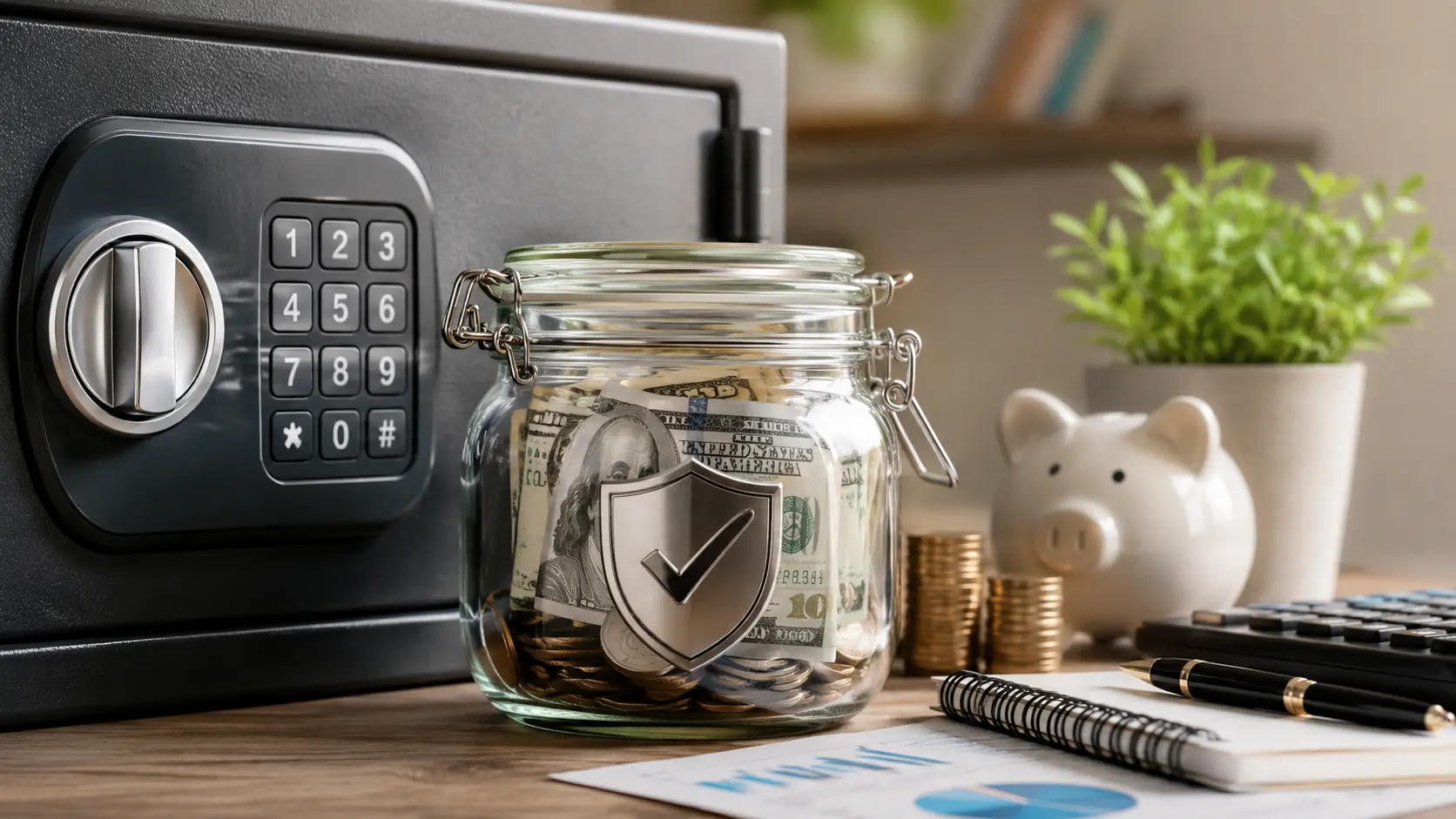

Finding the safest place to keep emergency fund savings is crucial if you want to protect your hard-earned money from both market volatility and inflation. While traditional checking accounts offer zero growth, choosing the right high-yield account ensures your money stays secure, accessible, and working for you when you need it most.
Your emergency fund is your life raft. If it’s in a checking account earning near zero percent annual interest, inflation is slowly and surely eroding its value. The good news is that you don’t have to put your emergency savings at risk in the stock market to do better. All you have to do is find better places to keep it.
Why Your Checking Account Is the Wrong Home for Emergency Cash
Many banks offer almost nothing on checking or basic savings accounts, making it harder to decide where the safest place to keep emergency fund savings really is. The national average savings account interest rate is only 0.38% APY, according to the FDIC, while inflation this year in 2026 is at 3.5% (according to the BLS CPI report for June 2026).
The math is simple, with $10,000 in a savings account at half a percent interest, you’re only earning $38 per year. The real number is much worse, when factoring in inflation. That same $10,000 would actually lose about $350 in purchasing power every year.
The simple solution is to find a better account, an account that rewards savers.
The Safest Places to Park Your Emergency Fund Right Now
An emergency fund has one job: be there, fully intact, the moment you need it. That rules out stocks, crypto, and anything that can drop in value on a bad week. Here’s what actually qualifies.
1. High-Yield Savings Accounts (HYSAs)
This is the easiest upgrade most people can make today. Online banks such as EverBank, Forbright Bank and Western Alliance offer between 3.80 and 4.15 percent APY, according to rate tracking sites NerdWallet and The Motley Fool. Your money is insured by the FDIC up to $250,000 and you can get it back in a day or two when you need it.
There’s no risk here. You don’t give up any safety compared to a checking account, and you get ten times the interest.
2. Money Market Accounts (MMAs)
A money market account is something like a HYSA; it offers a comparable level of FDIC insurance and competitive yields, though they may offer more flexible access (check-writing privileges) and/or a debit card. It is a good choice if you need to gain access to your funds without waiting for them to be transferred out of your HYSA.
3. Treasury Bills (T-Bills)
If you don’t mind a slightly more roundabout approach, consider Treasury bills. They’re as close to a risk-free investment as you can get, offering the security of the U.S. government’s full faith and credit. Short-term bills are paying about 3.7%, according to TreasuryDirect.gov and the Federal Reserve’s daily rates. You can buy them through TreasuryDirect.gov, or through discount brokers such as Fidelity, Charles Schwab, and Vanguard (no commission). Another benifit: They’re exempt from state and local taxes.
4. Money Market Mutual Funds
Government money market funds, such as Vanguard’s VMFXX, currently offer a rate of around 3.6% to 3.7%. Not insured by FDIC (as bank accounts are), these are otherwise conservative funds that hold a diversified portfolio of short-term government securities and are actually insured by SIPC (if held at a brokerage) while providing better return than cash.
Many investors have a money market fund as their default cash account within a brokerage.
5. No-Penalty CDs
Regular certificates of deposit tie up your money, which can be particularly frustrating when an emergency arises and you need access right away.With a no-penalty certificate you can do exactly that: you can take any funds out without penalty and without loss of earning potential.With a lot of banks offering nearly 4.30 APR for a one-year CD it’s also a pretty great investment opportunity if you know you’re not going to need the cash for at least a bit.
Quick Comparison: Where Should Your Emergency Fund Actually Live?
| Option | Typical Rate (2026) | FDIC/SIPC Insured | Access Speed |
| High-Yield Savings Account | 3.80% – 4.15% | FDIC | 1–2 days |
| Money Market Account | 3.50% – 4.00% | FDIC | 1–2 days, sometimes instant |
| Treasury Bills | ~3.70% | U.S. government-backed | At maturity or sale on secondary market |
| Money Market Mutual Fund | 3.55% – 3.70% | SIPC (not FDIC) | 1 day (T+1 settlement) |
| No-Penalty CD | Up to 4.30% | FDIC | Immediate, no penalty |
How Much Should Actually Be in Your Emergency Fund?
The standard advice to the emergency fund is three to six months of expenses – rent or mortgage, food, insurance, minimal debt payments. But if you’re a freelancer, on commission, or the only income in your household, shoot for six to nine months’ worth. Your situation dictates your needs, not the other way around.
Here’s my take: don’t let that “right” amount stop you from doing something. Even $1,000 in a high-yield savings account is better than $10,000 you don’t have yet.
The One Mistake to Avoid
Never keep the cash in emergency savings in the stock market, even in a “safe” index fund, even though the market makes sense when rates are low. Markets can go down 20% or more in any given year, and people tend to lose jobs when the economy is in recession, which is when the market tends to go down. Your emergency savings is not an investment vehicle. It’s insurance. It should be boring, safe, and kept separate from your investing cash.
Conclusion
Inflation is not going anywhere, and neither are emergencies. The only intelligent solution is to keep your emergency fund in a high yield savings account. Not only is a high yield savings account FDIC insured, it rewards you for keeping your money parked there. Open an account this week; in about ten minutes, your emergency fund will be earning money instead of slowly depreciating.